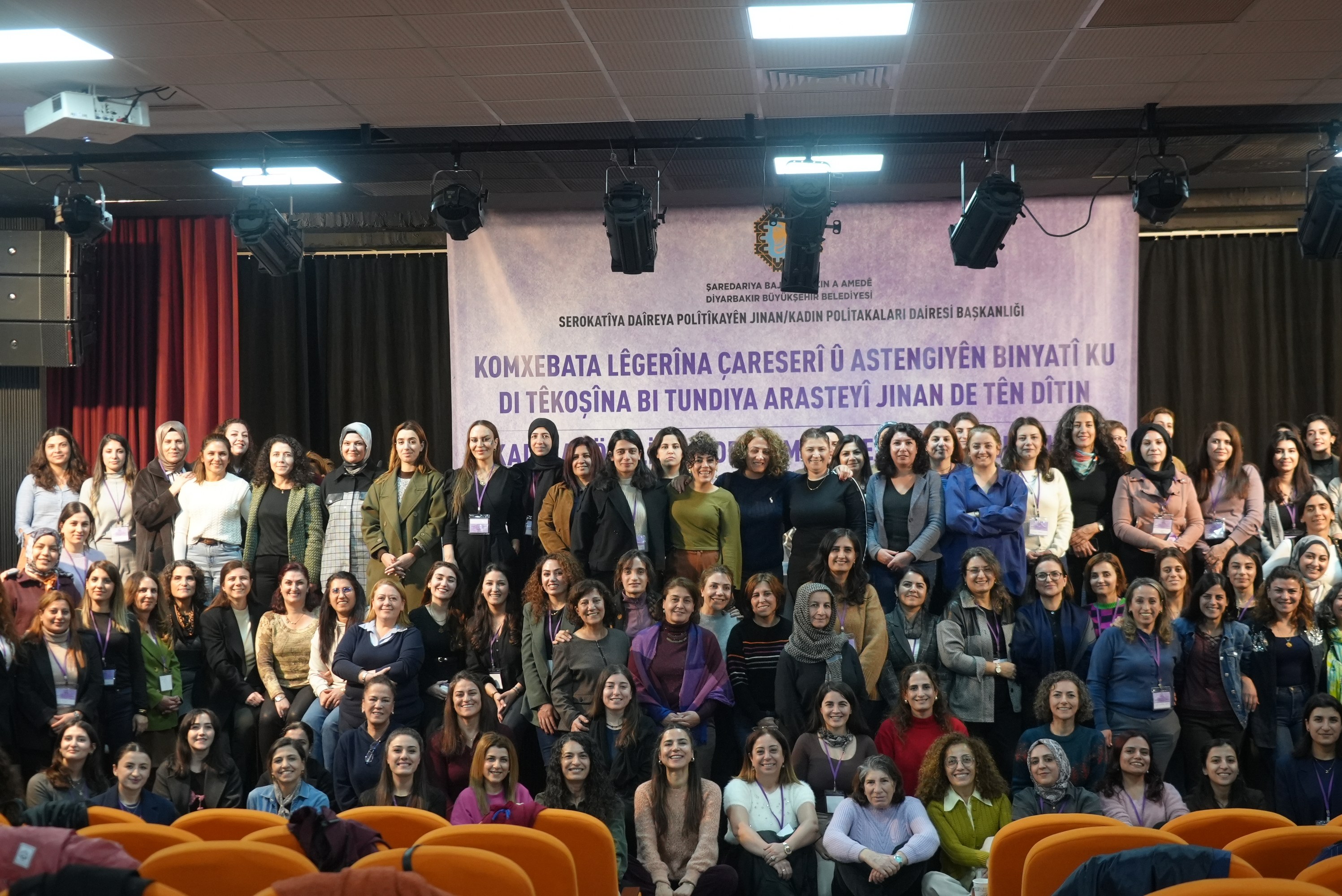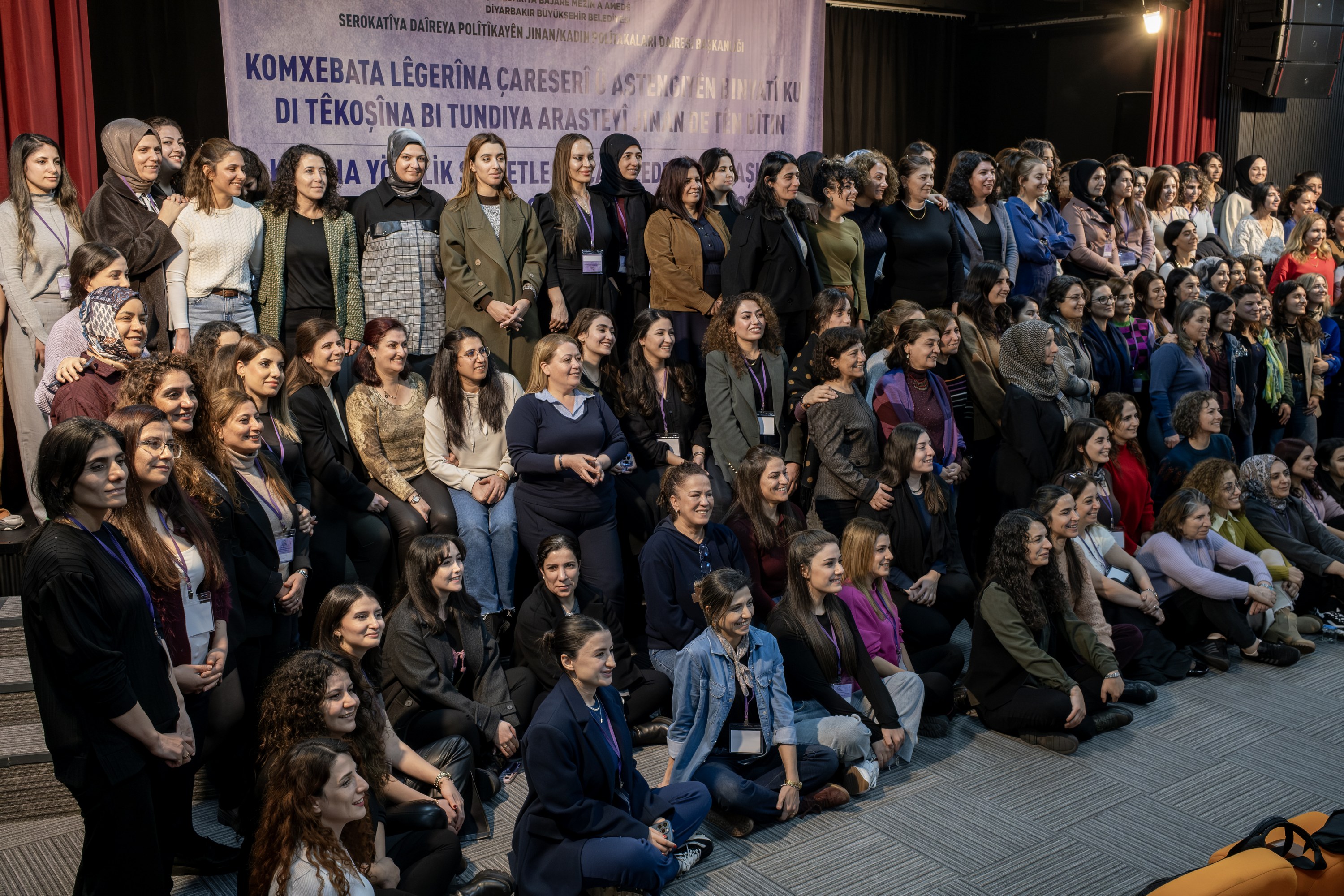
In the final declaration of the workshop titled “Structural Barriers Encountered in Combating Violence against Women and the Search for Solutions”, participants underlined that local authorities will ensure effective coordination with civil society organisations, women’s organisations and other local actors, and will pursue a multi-dimensional struggle against violence against women.
Hosted by Diyarbakır Metropolitan Municipality, the workshop was held on 29–30 November at the Ali Emiri Conference Hall in the municipal building, with contributions from Tevgera Jinên Azad (TJA), the DEM Party Women’s Assembly, the DEM Party Democratic Local Governments Women’s Council, the Union of Municipalities of the South East Anatolia Region (GABB), and women’s associations.
Over two days, the workshop created an important platform for discussion, drawing on the experience and accumulated knowledge of participants from local government, civil society and women’s organisations, and bringing into sharper focus the social and political dimensions of combating violence against women.
During the first day’s sessions, participants examined the access, resources and coordination challenges local authorities face in efforts to combat violence against women. Women working in the field also shared the multi-layered barriers they encounter, highlighting both the limitations of existing policies and the transformation that is needed. On the second day, discussions focused on innovative policies that could be developed in the fight against violence against women, as well as the responsibilities of political institutions within this struggle.
The workshop further explored how the untransformed structure of politics is reflected in women’s lives, where current policies become blocked, and what kind of political will is required for steps that can create genuine change on the ground. In the open discussion session, participants shared proposals for solutions, agreeing that real implementability is only possible through strong public pressure, a determined political stance and solidarity-based local organising.
Workshop’s final declaration released
In the final declaration issued at the conclusion of the workshop, participants underlined that violence against women is not merely an individual problem, but deepens as a consequence of a millennia-old male-dominated system and gender inequality. The declaration stated: “As is the case globally, violence against women in our country is a problem shaped by social structures, the economic order, cultural norms and the political climate—one that systematically exposes women to discrimination. In this context, violence is an ongoing attack on women’s lives, social status, identities and rights.”
Pointing to the need for deeper structural transformation
The declaration also drew attention to the fact that, particularly in the region, women face not only violence rooted in patriarchal mindsets, but also state violence and the brutal consequences of war. It continued: “This shows that the problem we must confront is not limited to violence alone; it also encompasses deeper processes of structural transformation, including demands for gender equality, freedom and equality. In this context, policies pursued in combating violence against women must develop more comprehensive and effective solutions. A solution will be possible not only by providing support to women subjected to violence, but by building a liberatory and egalitarian social order grounded in gender equality.”
Violence against women is multi-dimensional
As social, economic and technological change accelerates globally, violence against women has also become increasingly multi-dimensional. In particular, new technologies have brought emerging forms of abuse such as stalking and digital violence, while dating violence has deepened and taken on new forms. Violence has become more visible; however, existing response and prevention mechanisms have not been effective in addressing these rapidly expanding dimensions. This underlines that combating violence against women is not only a matter of law and security, but also requires challenging and transforming sexist gender roles, inequality and the norms of a male-dominated mindset that underpin social structures.
Emphasis on education and awareness
Today, deepening sexist roles often render women’s exposure to violence invisible. Because of these social norms, women are frequently compelled to conceal violence and face difficulties in speaking out. For this reason, strengthening public awareness and social responsiveness is critical to enabling women subjected to violence to make their voices heard. In this context, education and awareness-raising efforts must be intensified in order to overcome patriarchal norms and sexist stereotypes, transform social structures, and address problematic attitudes and approaches.
Emphasis on accelerating legal processes
Gaps in legal procedures are among the most significant barriers in combating violence against women. Despite the enactment of Law No. 6284 on the Protection of the Family and the Prevention of Violence against Women in 2012, serious problems persist in practice. Lengthy legal proceedings, a culture of impunity for perpetrators of violence, and victim-blaming attitudes within the judiciary hinder women’s access to justice. Although the safety of women subjected to violence must be secured and protective measures implemented effectively, bureaucratic obstacles often lead women to withdraw their complaints. For this reason, the struggle must be strengthened through increased advocacy to speed up legal processes and to enhance criminal sanctions against perpetrators of violence.
A strong political will for advocacy must be demonstrated
One of the main actors bearing responsibility for the deepening of violence against women today is the political establishment. The limited scope of policies aimed at prevention, and the obstruction of reforms in the field of gender equality for political gain, make progress more difficult. Against the state’s and the ruling power’s misogynistic policies, political actors must adopt a clearer and more effective stance, and demonstrate strong political will at every level to defend women’s rights.
Lack of coordination and the need for a holistic approach
Discussions throughout the workshop also highlighted coordination gaps between local authorities, women’s organisations and civil society organisations as a major problem. Too often, support for women subjected to violence is left to a single institution, preventing the adoption of a holistic approach. In light of the criticisms raised, in-depth discussions were held on the points the women’s movement has been unable to overcome or resolve. A self-critical stance was taken regarding shortcomings in developing prevention policies and in creating lasting solutions in the post-violence process. Emphasising the importance of inter-institutional cooperation and coordination, participants reached significant shared decisions on this basis.
Peace and Democratic Society Process
It was also emphasised that the Peace and Democratic Society Process currently underway shows that overcoming these problems depends on social reconstruction, and that this process must be led by women. It was stated that transforming hegemonic masculinity is an essential part of this process, alongside strengthening the struggle for women’s freedom. In this direction, it was argued that combating violence against women is only possible through a political approach organised on the basis of democracy, equality and freedom.
Transforming the system of violence that targets women’s lives, identities and rights was framed not as the responsibility of women’s organisations or local authorities alone, but as the responsibility of all social institutions and political actors. The workshop once again made visible that women’s struggle for freedom is a political struggle—and that it constitutes one of the most fundamental steps towards social transformation.
Decisions adopted at the workshop
Following the discussions held during the workshop, the decisions adopted were set out as follows:
•Effective coordination will be established with civil society organisations, women’s organisations and other local actors. This coordination will enable women to access holistic support and will guide policymaking to deliver lasting and effective solutions in the fight against violence. Combating all consequences generated by “special war” policies—such as substance dependence, prostitution, poverty and forced displacement—will be a priority agenda item within this coordination framework.
•Campaigns and training programmes will be organised to raise public awareness of violence against women, covering all sections of society. Awareness-raising activities will also be carried out for staff working in the field of local government on combating violence against women.
•Accessibility of services to combat violence against women—particularly in rural areas—will be increased. Municipalities will establish the necessary infrastructure to ensure that women subjected to violence can easily access shelter, psychological support and legal assistance. Local authorities will also increase the financial and human resources required for combating violence against women, and update their strategic plans through gender-responsive budgeting.
•Comprehensive work will be undertaken on a communal economy, with a perspective aimed at strengthening women’s economy against policies that impoverish women.
•In order to facilitate women’s pursuit of justice, cooperation with legal institutions will be strengthened to speed up legal processes and to increase criminal sanctions against perpetrators of violence.
•Multi-faceted work will be carried out to develop self-defence awareness in all areas of life, with the aim of shaping and embedding women’s social contract.
•Policies will be developed to support women’s economic empowerment by creating education, employment and entrepreneurship opportunities, alongside various incentive programmes. Social policies will be expanded—such as opening nurseries/childcare centres (including zarokistan initiatives) and older people’s care centres—to relieve unpaid care work from being treated solely as women’s responsibility.
•The number of living centres where women can express themselves in the struggle against violence, act in solidarity and be empowered will be increased; women’s shelters will be transformed into free and enabling living spaces.
•With the aim of overcoming hegemonic patriarchal mindsets that lie at the root of social problems, widespread education activities will be carried out from a jineology perspective. In parallel, within the scope of combating domestic violence, the concept of the democratic family will be placed at the centre of social transformation.
•Taking into account the cultural richness and pluralism of the region, all activities will be carried out in the mother tongue.
•Policies will be developed to address the problems faced by refugee and migrant women, ensuring their access to services.
Multi-dimensional mechanisms
While emphasising that combating violence against women is an issue requiring cultural and social transformation, the declaration stated that overcoming the structural barriers identified is possible. It noted that the struggle waged by the women’s movement to date has produced social change, and that multi-dimensional mechanisms—such as education programmes, public awareness initiatives and accelerating legal processes—when pursued with a strong organising perspective, can open the way to lasting change.